Breaking Through Python's Performance Bottleneck: Architectural Evolution and Core Principles of the vLLM Rust Frontend
High-Concurrency LLM Inference in Practice — From ZMQ Boundary Design to Stream-Native Processing
Source video: Bilibili BV19fJJ6AE6W · Slides: vLLM Rust Frontend Introduction
GPU inference throughput doubles with each generation, yet the serving-side throughput ceiling has begun to hit a different bottleneck — the API Server frontend running in Python. The vLLM team's solution: use the ZeroMQ message boundary as the incision point and migrate the entire CPU-intensive frontend layer to Rust, while leaving the Python GPU engine untouched. Starting from the engineering tensions, this article dissects layer by layer the design motivations, tiered architecture, stream-native paradigm, tool-parsing mechanisms, deployment paths, and real-world benchmarks under extreme concurrency, while clearly delineating current functional boundaries and future directions.
Target Audience Backend or AI engineers with hands-on LLM deployment experience, familiarity with Python, and an interest in systems-level performance optimization and high-concurrency architecture.
Prerequisites
- Understanding of the basic LLM inference pipeline (Tokenization → Inference → Detokenization)
- Familiarity with how Python's GIL impacts concurrency performance and the limitations of multi-process architectures
- Basic knowledge of inter-process communication (IPC) and ZeroMQ concepts
Reading Objectives
- Understand the engineering context and core tensions behind vLLM's introduction of a Rust frontend
- Grasp the ZMQ-based frontend–backend separation architecture and its advantages
- Understand the single-source-of-truth principle in the Stream-Native architecture for handling streaming output
- Obtain performance benchmark data and applicability boundaries under extreme concurrency scenarios
1. The Emerging Tension: GPU Compute Overflow vs. the Python Frontend Bottleneck
Core question for this section: As GPU-side inference latency keeps dropping and throughput keeps climbing, where does the system's performance ceiling shift to?
The Frontend Does Far More Than HTTP Forwarding
Many people's first impression of the vLLM frontend is that it simply "receives requests and passes them through to the engine." In reality, as model diversity and application scenarios have expanded, the CPU-intensive responsibilities shouldered by the frontend have grown substantial. The table below lists the work the frontend must complete during a typical Chat Completions call:
| Stage | Typical Operations | CPU-Intensive Characteristics |
|---|---|---|
| API Layer | Schema validation, error handling, SSE (Server-Sent Events) chunked streaming | String parsing and serialization |
| Input Processing | Applying a Chat Template to flatten structured conversations into a string; Tokenization; multimodal image loading and preprocessing | Each model has its own template and parameters, requiring per-request execution |
| Output Processing | Incremental Detokenization (progressively converting raw tokens returned by the engine back into text); Stop String detection; extracting Tool Calls according to model-specific grammars and structuring them | High-frequency per-token loops; different models use different Tool Call Parsers |
| Operational Functions | Request lifecycle management, cancellation handling, load-balanced routing across Data-Parallel ranks, metrics collection | Involves global state coordination |
Key observation: Virtually every item above is pure CPU computation, not idle I/O waiting on the GPU. As concurrent requests increase, these tasks compete intensely for CPU time.
The Causal Chain: The Faster the GPU, the Harder Python Struggles
- GPU inference accelerates — Hardware vendors and engine-level optimizations continually reduce inter-token latency and push throughput higher.
- Frontend pressure rises in lockstep — The more tokens the engine produces per second, the more frequently the frontend must perform Detokenization, Tool Call parsing, SSE chunking, and so on.
- Python's inherent limitations are amplified — Three characteristics compound into a bottleneck in this scenario:
- GIL (Global Interpreter Lock): Only one thread can execute Python bytecode at a time; true parallelism is impossible when handling concurrent requests.
- Dynamic Typing: Runtime type checking incurs additional overhead; high-frequency loops suffer significant performance penalties under interpreted execution.
- GC (Garbage Collection): Unpredictable pauses make tail latency under high concurrency difficult to control.
- The cost of the multi-processing workaround — To circumvent the GIL, Python typically resorts to multi-process architectures. But multiple processes mean separate memory spaces, IPC overhead, and more complex state coordination logic — a non-trivial "architecture tax" in its own right.
Rust stands in stark contrast: no GIL, no GC, capable of high concurrency within a single process, with memory management determined at compile time — characteristics that are a natural fit for high-throughput frontend scenarios.
Beyond Speed: Correctness Requirements in the Agentic Era
Performance is not the only driving force. Today's LLM workloads have evolved from simple Q&A to agentic scenarios — long conversations, multi-turn Tool Calls, and Structured Output. In an agent loop, any subtle frontend error (type mismatch, missed Tool Call parsing, truncated streaming output) breaks the entire execution chain and is difficult to recover from externally.
Python's weak typing means many low-level errors surface only at runtime; Rust's compiler is famously strict, catching a large class of such issues at compile time. Meanwhile, the maturity of AI-assisted coding tools has dramatically lowered Rust's learning curve — the original core argument for sticking with Python was "lowering the contributor barrier," but that trade-off has now reversed: when contributors can efficiently write Rust with AI assistance, compile-time strictness becomes a quality guardrail for large-scale community collaboration.
Summary
The Python frontend played a tremendous role in vLLM's early growth; its ecosystem affinity was a key factor in the project's rapid expansion. The current bottleneck has not yet manifested under all workloads — rather, it is a ceiling that draws ever closer as GPU compute grows and frontend responsibilities expand. The scope of the Rust rewrite is strictly limited to the frontend side — the engine and GPU side continue to run mature Python code, unaffected.
Given that the Python frontend has become the bottleneck, how can it be replaced without disrupting the existing, battle-tested Python GPU inference engine?
2. Breaking the Architectural Impasse: Physical Isolation of Frontend and Backend via ZMQ
Core question for this section: If frontend and backend code are coupled within the same process and the same language, a clean language substitution is nearly impossible. What mechanism does vLLM use to decouple the frontend from the backend?
The Big Picture
The diagram below shows the three-tier component relationships and communication boundaries of the entire vLLM serving stack in its deployed state. It is the foundation for understanding every design that follows.
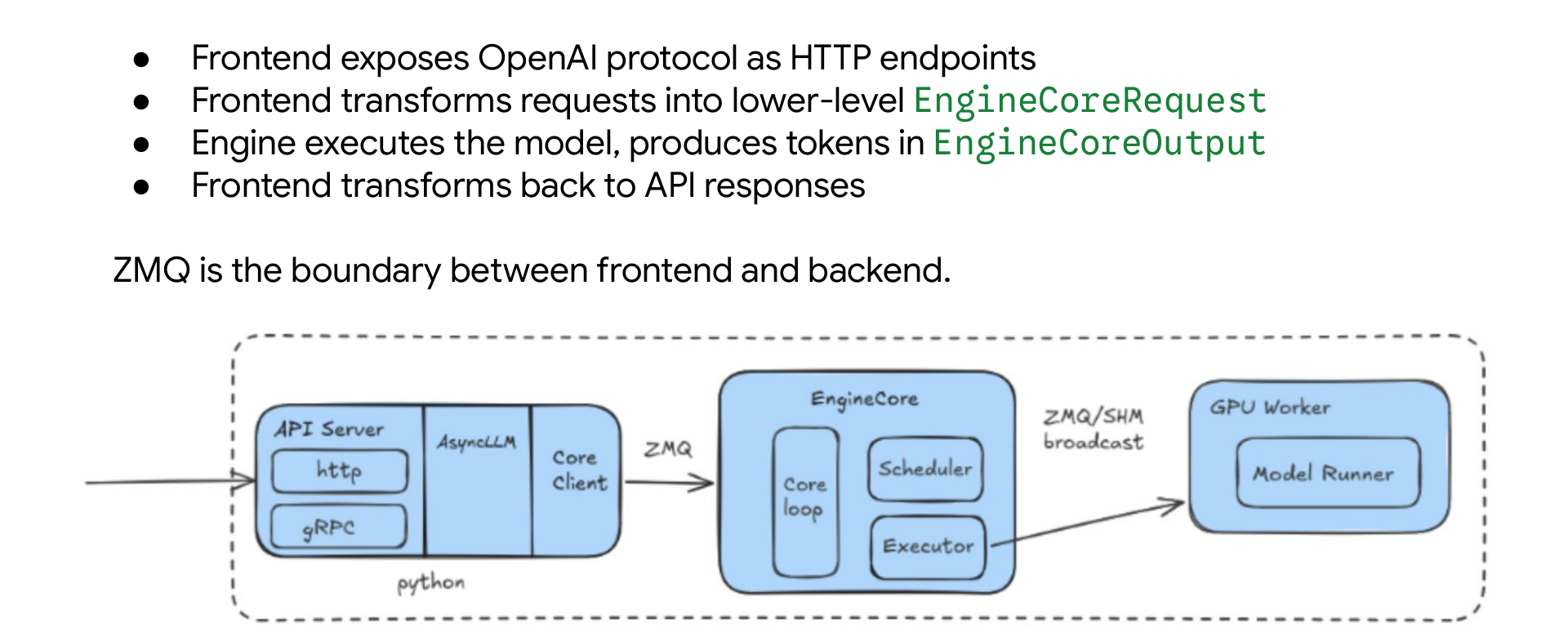 Figure: vLLM Serving Stack tiered structure. Source: presentation slides, page 3.
From left to right, the diagram presents three tiers:
| Tier | Component | Process | Primary Responsibility |
|---|---|---|---|
| Frontend | API Server: HTTP/gRPC Endpoint → AsyncLLM → Core Client | Separate process | Exposes an OpenAI-compatible interface; translates structured requests into low-level EngineCoreRequest messages |
| Backend | EngineCore: Core Loop → Scheduler → Executor | Separate process | Manages the KV Cache, schedules requests, drives model forward passes |
| GPU Workers | GPU Worker → Model Runner | Potentially cross-node | Executes actual model computation and generates tokens |
The arrow connecting the frontend and backend is labeled ZMQ (ZeroMQ, a high-performance asynchronous messaging library); the arrow connecting EngineCore and GPU Workers is labeled ZMQ / SHM broadcast. The three tiers run in different processes — potentially on different machines — and interact via serialized messages rather than function calls within a shared memory address space.
The Causal Chain: How ZMQ Makes Language Substitution Possible
- Introduce a ZMQ message queue → The frontend and backend no longer share a Python interpreter or a GIL.
- Establish an IPC boundary → The sole contract between frontend and backend degenerates to two message formats:
EngineCoreRequest(frontend → backend) andEngineCoreOutput(backend → frontend). - The contract is language-agnostic → As long as a new frontend can correctly construct and parse these two message types, the backend need not know whether the frontend is written in Python or Rust.
- The backend Python GPU engine remains untouched → The scope of the replacement is strictly confined to the left side of the ZMQ boundary.
In local deployment scenarios, ZMQ uses the IPC protocol with extremely low latency; in distributed deployments, it switches to TCP while keeping the same message format.
State Progression: The Lifecycle of a Single Request
Taking /v1/chat/completions as an example, the request flows across the ZMQ boundary as follows:
User HTTP Request
    │
    ▼
[Frontend] API Server receives JSON, validates schema,
           applies Chat Template to flatten into a prompt
    │
    ▼
[Frontend] Core Client wraps it into an EngineCoreRequest
    │
    ▼
  ──── ZMQ (IPC / TCP) ────
    │
    ▼
[Backend] Core Loop deserializes; Scheduler allocates KV Cache and enqueues into a batch
    │
    ▼
[Backend] Executor drives GPU Workers to perform forward passes, progressively producing tokens
    │
    ▼
[Backend] Wraps output into an EngineCoreOutput
    │
    ▼
  ──── ZMQ (IPC / TCP) ────
    │
    ▼
[Frontend] API Server converts the token stream into SSE chunks and streams them back
The ZMQ boundary is crossed exactly twice: once to send the request, once to receive the output. All CPU-intensive frontend work is contained on the left side of the boundary; all GPU-intensive backend work is contained on the right.
Conclusions and Boundaries
The ZMQ message boundary is the critical cornerstone enabling heterogeneous-language collaboration: it splits the system in two, allowing the frontend to be independently replaced with Rust (or any language capable of constructing valid messages) while leaving the backend unaffected. It is important to note, however, that this isolation does not make the frontend "thin" — API validation, multimodal input processing, model parameter adaptation, and the conversion from token streams to SSE chunks all reside on the frontend side.
With the communication boundary established, how is the Rust frontend internally organized to handle these complex responsibilities?
3. Core Design: The Five-Layer Architecture of the Rust Frontend
Core question for this section: What stages does an OpenAI-formatted HTTP request pass through from entering the Rust frontend to being serialized into a binary message consumable by the engine?
Architectural Overview
To understand the complete journey of a request inside the frontend, consider the layered architecture diagram below — it shows the five vertically stacked modules of the Rust frontend from top to bottom, along with the independent model-specific components at the base.
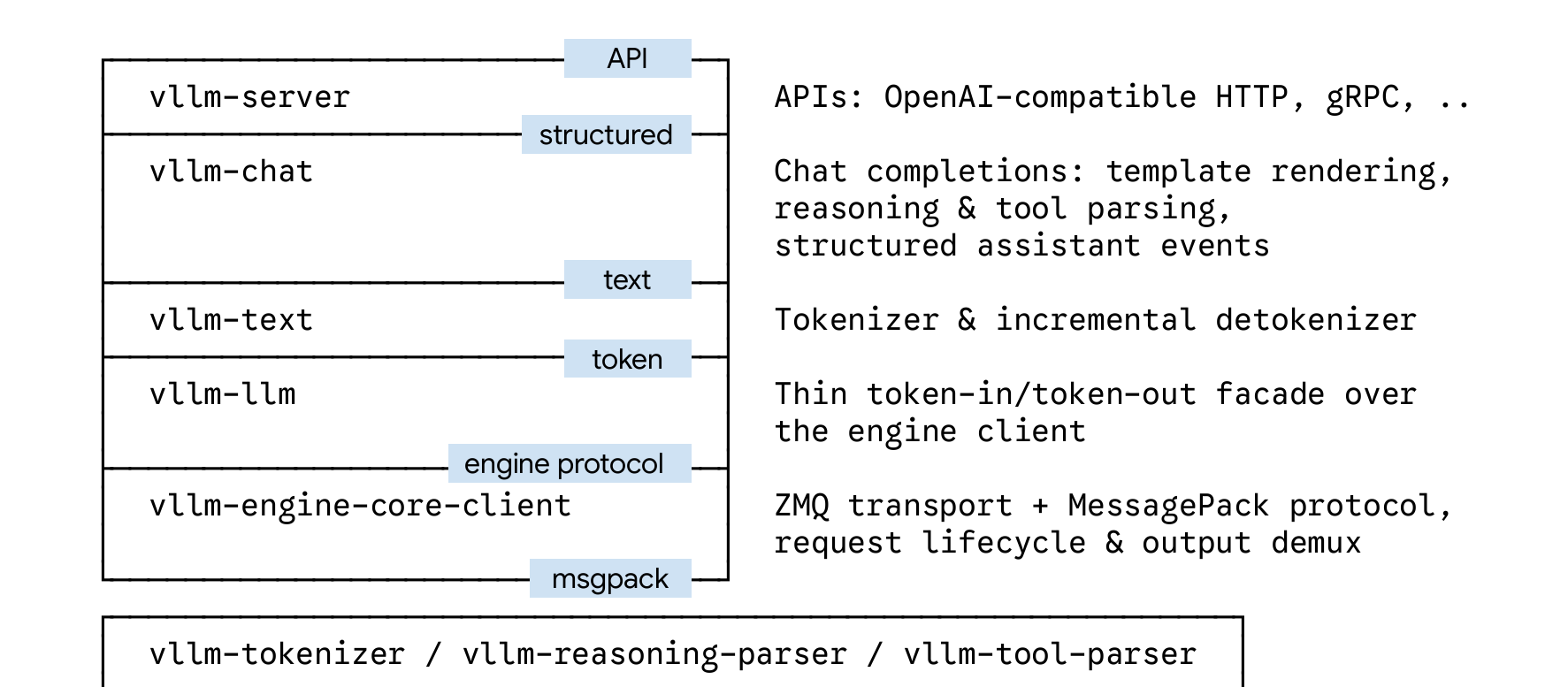 Figure: Rust frontend layered architecture. Source: presentation slides, page 8.
On the left side of the diagram are the five vertically stacked blue modules; on the right are annotations indicating the input/output semantics and key protocols at each layer. At the bottom sit three independent modules responsible for model-specific implementations. The core principle is: each layer speaks only one "language," and layers communicate through explicitly defined interfaces.
Layer-by-Layer Breakdown
| Layer (top to bottom) | Input Form | Core Responsibility | Output Form |
|---|---|---|---|
| vllm-server | HTTP / gRPC requests | Exposes OpenAI-compatible endpoints; extensible to additional API styles in the future | Unified structured conversation representation |
| vllm-chat | Structured conversation | Chat Template rendering, Reasoning parsing, Tool parsing, converting text output into a structured Assistant Event stream | Structured event stream |
| vllm-text | Plain text | Tokenization, incremental Detokenization, Stop String detection | Token sequences / text |
| vllm-llm | Token sequences | A thin facade over the engine client — hides underlying encoding details, exposes a Rust-native interface | Engine protocol-level requests |
| vllm-engine-core-client | Engine protocol messages | ZMQ transport, MessagePack (MsgPack, an efficient binary serialization format) encode/decode, request lifecycle management, demuxing of batched outputs | MsgPack binary frames |
vllm-server directly faces users, translating external requests from various protocols into a unified internal representation before passing them downward. Different API styles require only a lightweight mapping at this layer; all lower layers are fully reused.
vllm-chat receives the complete conversation context and performs template rendering and reasoning/tool parsing. On the reverse data path, it reassembles the raw text produced by lower layers into structured events — a critical component for ensuring Tool Call and Reasoning chains remain unbroken in agent scenarios.
vllm-text accepts and returns only text looking upward, and exchanges only token sequences looking downward. The boundaries of Tokenization and incremental Detokenization are fully enclosed within this layer.
vllm-llm is an extremely thin abstraction that replaces transport-encoding-bound structures with more Rust-native types. It can also be called directly as a Rust library by external orchestration frameworks (e.g., Dynamo), bypassing Python overhead entirely.
vllm-engine-core-client handles every detail of communicating with the EngineCore — ZMQ connections, MsgPack encode/decode, sending requests and receiving batched replies, and demuxing multi-request aggregated outputs by request ID back into their respective response streams.
The Model-Agnostic Principle
No model-specific branching logic exists anywhere in the five-layer main pipeline. All model-specific behavior — dedicated tokenizers, differing Reasoning Parser and Tool Parser implementations — is extracted into the three independent modules at the bottom of the diagram (vllm-tokenizer, vllm-reasoning-parser, vllm-tool-parser) and plugged into the main pipeline via traits/interfaces. Adding support for a new model requires only implementing the corresponding trait, with no changes to the main pipeline code.
Minimal Example: The Journey of a Chat Request
Suppose a user sends POST /v1/chat/completions containing a multi-turn conversation:
- vllm-server parses the HTTP request body, validates fields, and converts it into a unified internal conversation structure.
- vllm-chat renders the conversation into a complete prompt text using the model's Chat Template, and registers Reasoning Parser and Tool Parser callbacks.
- vllm-text invokes the Tokenizer on the prompt to produce a token sequence.
- vllm-llm wraps the token sequence into an engine-understandable request structure.
- vllm-engine-core-client serializes it into a MsgPack binary frame and sends it to the EngineCore via ZMQ.
On the reverse path, the EngineCore's batched output is demuxed at Layer 5 to the corresponding request and progressively restored upward: tokens → text → structured Assistant Events → HTTP SSE stream.
Conclusions and Boundaries
The strict five-layer separation yields three direct benefits: separation of concerns (each layer handles only one data form), reusability (different API protocols share the same underlying implementation), and independent testability (any layer can be validated in isolation). It should be noted that multimodal request processing has not yet been fully integrated into this layered system; the current five-layer architecture primarily covers Chat/Completion scenarios in the text modality.
The layered architecture addresses the problem of request dispatch, but the defining characteristic of LLM inference is streaming output — the engine generates results token by token. How does the Rust frontend efficiently handle this reverse data flow?
4. Data Flow: The Stream-Native Design
Core question for this section: Many frontend implementations maintain separate "streaming" and "non-streaming" code paths, ultimately producing inconsistent results at edge cases. Why does the vLLM Rust frontend elevate streaming to a first-class citizen?
The Fundamental Tension: The Engine Is Streaming, but the Frontend Forks
The inference engine produces a new token upon completing each decoding step — the raw output is inherently a temporally unfolded event stream. When the frontend must simultaneously provide an SSE streaming interface and a standard JSON one-shot response interface, the intuitive approach is to write separate processing logic for each — the streaming path pushes each token immediately upon arrival; the non-streaming path waits for all tokens to be ready before assembling them at once.
The problem is: the streaming path can only conservatively process the information available so far; the non-streaming path has a complete "god's-eye view" and can make more aggressive decisions. The two strategies cause the same request to return different results depending on which mode is selected. Such divergence does exist in the Python-side Tool Parser and Reasoning Parser — the non-streaming path sometimes errs by being too greedy, while the streaming path in other scenarios is too conservative and loses information.
Core Design: Every Layer Is a Transformation on a Stream
The Rust frontend's solution can be summarized in one sentence: the entire processing pipeline uses the stream as its sole data channel, with each layer acting as a Stream Transformer.
| Layer | Input | Transformation | Output |
|---|---|---|---|
| Engine Client | Engine decode results | Converts low-level protocol frames into standardized output | EngineOutput event stream |
| Text Layer | EngineOutput |
Decodes Token IDs into text deltas | DecodedTextDelta event stream |
| Chat Layer | DecodedTextDelta |
Assembles structured events per Chat Completion semantics | ChatEvent event stream |
| Server Layer | ChatEvent |
Serializes to HTTP format | SSE chunks or complete JSON |
Every layer operates in the same mode: receive an upstream event → update internal state → determine whether yield conditions are met → push an incremental event downstream. State is naturally embedded in each layer's local context, eliminating the need to manually maintain complex state-transition matrices.
Minimal State Progression Example
Suppose the engine sequentially generates three tokens: "Hello" → " world" → "!".
Streaming request event chain:
Token₁ → delta="Hello"  → ChatEvent{delta:"Hello"}  → SSE: {"choices":[{"delta":{"content":"Hello"}}]}
Token₂ → delta=" world" → ChatEvent{delta:" world"} → SSE: {"choices":[{"delta":{"content":" world"}}]}
Token₃ → delta="!"      → ChatEvent{delta:"!"}      → SSE: {"choices":[{"delta":{"content":"!"}}]}
[done]  → —              → ChatEvent{finish}          → SSE: [DONE]
Non-streaming requests do not follow a separate path; they reuse the same pipeline. All events pass through the same four-level transformation and are yielded individually. At the Server Layer, they are simply collected (aggregated) into a complete JSON response in one shot. Non-streaming is nothing more than one-shot & collect — run the stream to completion, then gather the results. The core incremental processing logic does not change at all.
The Single Source of Truth Principle
Single Source of Truth is the core guarantee of this design:
- There is only one processing pipeline in the system; no independent non-streaming branch exists.
- Regardless of whether the request asks for streaming output, tokens undergo the exact same decoding, assembly, and event-generation process.
- Any bug fix at any layer takes effect for both modes simultaneously — there is no possibility of "fixed for streaming, missed for non-streaming."
Conclusions and Boundaries
The Stream-Native design elevates streaming from an "optional feature" to an "architectural cornerstone," making non-streaming a degenerate special case of streaming and fundamentally eliminating the edge-case inconsistencies that arise from maintaining dual code paths. However, this design requires that every layer's transformation be capable of operating incrementally — for scenarios that require "seeing the complete output before making a decision" (e.g., complex tool-call parsing), the implementation difficulty of incremental transformers rises significantly. This is precisely the problem addressed in the next section.
5. Mechanism Optimization: Streaming Tool Parsing via Parser Combinators
Core question for this section: When facing complex structured output and tool calls, how does the Rust frontend avoid the parsing errors inherent in traditional regex-based matching?
Why Tool Call Parsing Is Perpetually Buggy
LLM tool-calling formats vary by model — some use JSON, some use XML-like markup (e.g., DeepSeek V3's DSML format), and some allow recursive nesting. In the Python frontend, each model's tool parser independently maintains its own set of regular expressions, ad-hoc string concatenation logic, and hand-written state machines, with virtually no code reuse.
This leads to a steady stream of edge-case patches for model-specific parsers in the vLLM Python repository. But the root cause of these bugs is not that the model produced illegal syntax — rather, the model produced perfectly valid markup that the frontend parser failed to handle correctly. The bulk of the fix effort is actually compensating for the frontend's own parsing deficiencies.
Why Regular Expressions Fail in Streaming Scenarios
The core tension lies in the "arbitrary truncation" nature of streaming output:
| Stage | State | Regex Approach Dilemma |
|---|---|---|
Received <dsml |
Incomplete tag | Regex cannot match half a tag; requires additional state tracking |
Then received _tool_calls> |
Tag closed | Requires backtracking and concatenation; logic scattered across multiple locations |
| Received nested content | Recursive structure | Regex is inherently ill-suited for recursive matching |
| Received unexpected stream interruption | Error recovery | Hand-written state machine branch explosion |
Regular expressions are tools designed for "complete input at once," whereas a streaming token stream is inherently incremental and interruptible. Forcing regex into this role necessitates manually maintaining a large amount of intermediate state, and every new model format requires rewriting the logic from scratch.
The Solution: Parser Combinators
Parser Combinators are a functional programming technique — the parsing task is decomposed into small, composable parsers (e.g., "match an angle bracket," "match a tag name," "match an attribute"), which are then declaratively assembled into a complete parser through combinators (sequence, choice, repetition, etc.).
The diagram below illustrates how the DSML XML-like structure is parsed, the key characteristics of the combinator approach, and the behavioral differences between the old and new approaches when encountering truncated input.
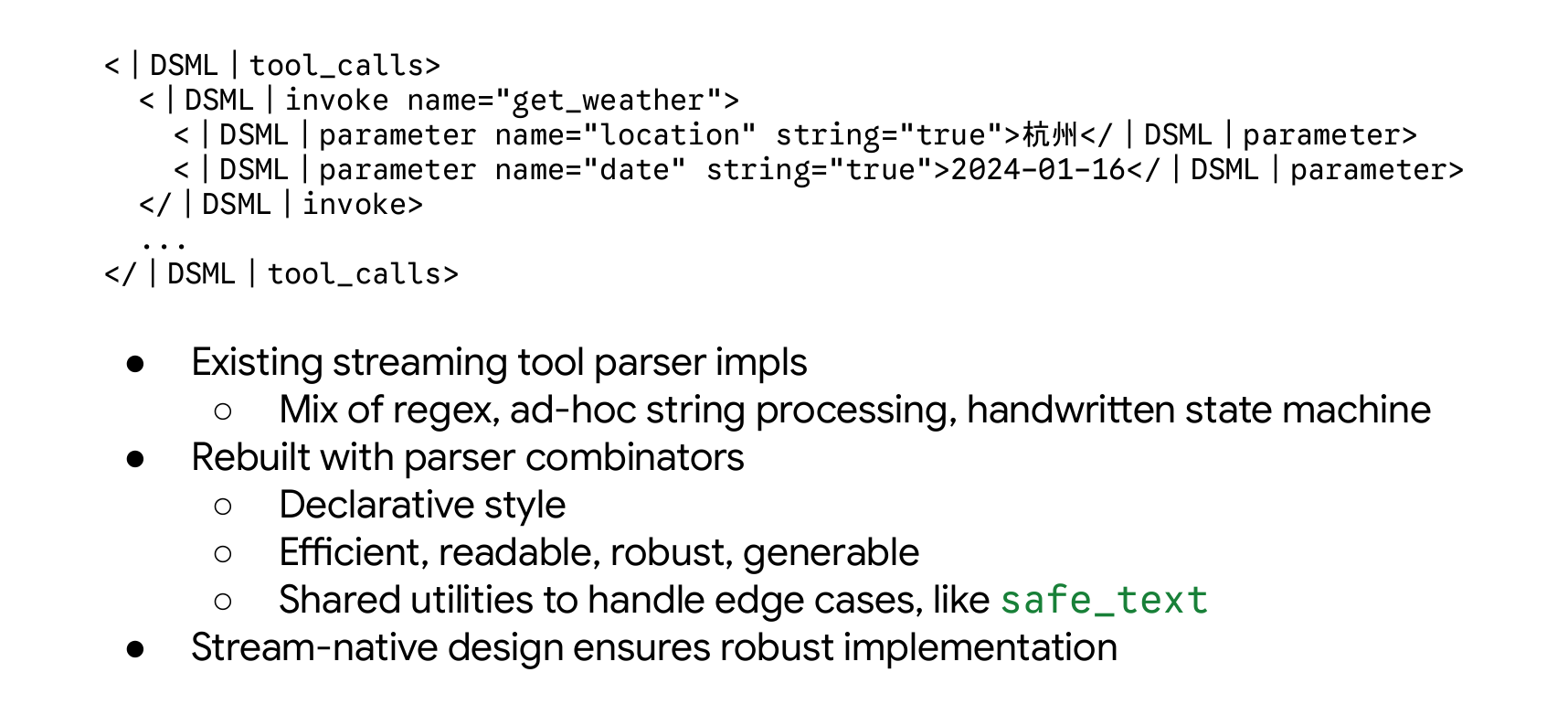 Figure: Old vs. new implementation of the streaming tool parser. Source: presentation slides, page 10.
The diagram shows a DSML structure similar to XML tag pairs, containing an opening tag (e.g., <dsml_tool_calls>), a tool name, a parameter body, and a closing tag. The Rust frontend uses combinators to directly describe the grammar shape for this structure, rather than using regex to capture text fragments. This yields three key advantages:
- Declarative readability: The code is practically a direct description of the grammar, with no need to jump between regex escapes and state variables.
- Execution efficiency: The grammar shape is determined at compile time, eliminating the runtime cost of compiling regex into state machines.
- Ease of extension: Adding a tool parser for a new model requires only describing its grammar structure; in practice, the team has even used AI to assist in generation, with parsers passing all upstream test cases nearly on the first attempt.
Minimal Example: Suspension and Resumption on Truncated Tokens
Suppose a model's tool-call opening marker is <dsml_tool_calls>, and the streaming output produces the following token sequence:
When Token 1 arrives, the combinator parser recognizes that <dsml could be the prefix of a special marker. At this point, a shared utility function called safe_text is triggered — it intercepts the token and withholds it from the client, because it cannot yet determine whether this is ordinary text or the beginning of a tool-call marker.
When Token 2 arrives, the combinator concatenates the two segments into <dsml_tool_calls>, confirms a match with the opening tag, and immediately transitions into "entering tool-call body" mode. If Token 2 had been non-matching content (e.g., _other_text), the combinator would confirm this is not a special marker, and the previously intercepted text would be released normally to the client.
This "intercept — wait — confirm/release" pattern appears in every streaming tool parser. In the Python approach, each model implements it independently; in the Rust approach, generic patterns like safe_text are extracted into shared infrastructure, and all model parsers reuse the same thoroughly tested primitives.
Conclusions and Boundaries
Parser combinators fundamentally eliminate the class of "frontend-induced tool-parsing bugs." Because they adopt the same stream-native design as the overall architecture, the Rust tool parsers have no "full-replay" path — each token is fed directly into the incremental pipeline, and the state machine iterates on its own.
It should be noted that the presentation materials did not provide quantitative performance comparison data between the combinator approach and the Python regex approach; the core benefits are primarily in correctness and maintainability. Furthermore, when a model's tool-calling syntax is inherently ambiguous, no parsing approach can fully eliminate errors — combinators solve the problem of "valid output being misclassified."
With the architecture and mechanisms in place, how do users actually deploy and connect to this entirely new Rust frontend?
6. Deployment Evolution: From Drop-in Replacement to Pure-Rust Startup
Core question for this section: How can existing vLLM users migrate to the Rust frontend with minimal cost?
Two Progressive Paths
The Rust frontend has been merged into the vLLM main repository and shipped with version 0.22 — it is not a separate branch but part of mainline. Users have two integration options: one requires changing only a single environment variable; the other eliminates Python from the startup chain entirely.
To understand the process topology differences between the two approaches, first consider this architecture diagram of the pure-Rust entry point.
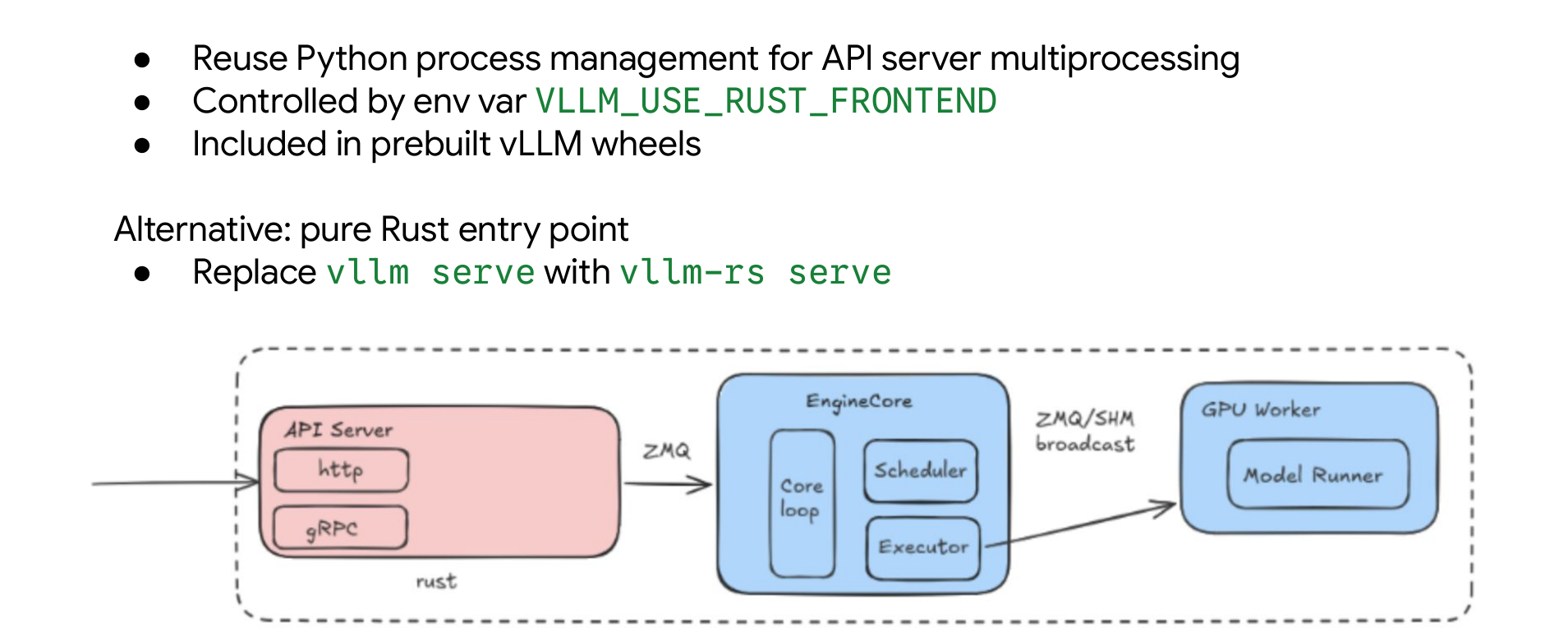 Figure: Rust frontend integration approach and internal process structure. Source: presentation slides, page 11.
The three regions in the diagram are the Rust-written API Server, the Python-written EngineCore (containing Core Loop, Scheduler, and Executor), and the Python-written GPU Worker (Model Runner). The communication boundaries between them remain ZMQ and shared memory. Precisely because ZMQ decouples the frontend and engine into independent processes, "replacing only the process in front of ZMQ" becomes feasible.
Path 1: Environment Variable Drop-in Replacement
vLLM's Python entry point already manages the API Server as an external process at startup. The Rust frontend leverages this: the compiled Rust binary "masquerades" as an API Server process to be managed, launched by the Python-side process manager.
The only thing the user needs to do:
After setting this environment variable:
- The Python entry point parses command-line arguments and initializes EngineCore as usual;
- At the API Server spawn stage, it detects the environment variable and launches the pre-compiled Rust binary instead of Python's UVicorn server;
- The Rust frontend establishes a connection with EngineCore via ZMQ, and all subsequent request handling is performed entirely by Rust.
EngineCore, GPU Workers, model weight loading, scheduling logic — everything beyond the ZMQ boundary remains completely unchanged. In prebuilt vLLM wheel packages and official container images, the Rust binary is already bundled — no additional compilation is required.
Path 2: Pure-Rust Entry Point
To remove Python from the startup chain entirely, use the standalone pure-Rust entry point:
In this mode, the Rust process starts as the main process, parses arguments itself, and spawns the EngineCore (Python) as a child process. The process structure becomes extremely clean — only two types of processes exist: the Rust frontend and the Python engine. vllm-rs serve strives to maintain argument compatibility with vllm serve, but UVicorn-related configuration options (such as worker count and other Python-specific settings) no longer apply.
Migration Decision Table
| Dimension | Drop-in Replacement | Pure-Rust Entry Point |
|---|---|---|
| Startup command | VLLM_USE_RUST_FRONTEND=1 vllm serve … |
vllm-rs serve … |
| Python dependency | Python still needed for process management | No Python in the startup chain |
| Configuration compatibility | Fully compatible with existing arguments | UVicorn-specific options unsupported |
| Packaging | Distributed with wheel / image | Standalone Rust binary |
| Maturity | Currently recommended integration method | Forward-looking evolutionary direction |
Conclusions and Boundaries
The progressive dual-path design lowers the migration barrier: production services can first switch transparently via the environment variable, then consider the pure-Rust entry point after validating stability. The pure-Rust entry point is still in its evolutionary phase; quantified startup acceleration benefits have not yet been disclosed in public benchmarks.
Do the theoretical architectural improvements actually deliver a performance leap? The next section answers with real-world benchmark data under extreme concurrency.
7. Performance Validation: Throughput and Latency Under Extreme Concurrency
Core question for this section: Under the extreme pressure of 1,024 concurrent connections, how large is the gap between the Rust and Python frontends in throughput and response latency?
Experimental Constraints
All data below come from the benchmarks published in the presentation slides, under the following constraints:
| Parameter | Value |
|---|---|
| Model | Qwen3-0.6B (an extremely small model, chosen to push the bottleneck toward the frontend rather than GPU compute) |
| GPU | 4× GB200 |
| Data parallelism (DP) | 4 |
| Request send rate | Infinite (infinite request rate) |
| Concurrent connections | 1024 |
The choice of a 0.6B model is deliberate: when the model's own GPU compute overhead is extremely low, the system's overall throughput is more easily constrained by frontend capacity, thereby amplifying the frontend performance differential to an observable degree.
Scenario 1: Decode-Sensitive Workload
This scenario simulates a typical streaming generation workload — short input, long output — where the frontend must continuously receive and forward a large volume of intermediate tokens.
Workload characteristics: Input length 32 tokens, output length 512 tokens, Prefix Cache disabled.
Throughput comparison:
| Frontend Configuration | Processes | Throughput (req/s) |
|---|---|---|
| Rust | 1 | 559.79 |
| Python (asc=16) | 16 | 521.80 |
Data source: presentation slides, page 12. asc = API Server process count. Constraints: Qwen3-0.6B / DP=4 / 4×GB200 / concurrency=1024.
Latency performance: The Rust frontend's TTFT (Time to First Token) and TPOT (Time per Output Token) at both the P50 and P90 percentiles are significantly lower than those of the Python 16-process configuration.
Causal analysis: Each request requires the frontend to perform 512 SSE streaming pushes. Constrained by the GIL, Python's in-process concurrent I/O suffers from serialization bottlenecks, with responses queueing in the event loop. Spawning more processes alleviates queueing but introduces context-switching overhead and uneven cross-process load balancing. Rust's Tokio runtime achieves true parallel processing of I/O events from thousands of connections within a single process via its multi-threaded work-stealing scheduler, resulting in higher throughput and a tighter latency distribution.
Rust single-process throughput exceeds Python 16-process by approximately 7.3% ((559.79 − 521.80) / 521.80 ≈ 7.3%), while the latter consumed 16× the process resources.
Scenario 2: Preprocess-Sensitive Workload
This scenario concentrates pressure on the frontend's request preprocessing stage — extremely long input, very short output — with a pre-warmed Prefix Cache that minimizes GPU-side Prefill compute overhead. Tokenization, Chat Template rendering, and HTTP request deserialization time become the absolute dominant factors.
Workload characteristics: Input length ~10,000 tokens, output length 16 tokens, Prefix Cache fully warmed.
Throughput comparison:
| Frontend Configuration | Processes | Throughput (req/s) |
|---|---|---|
| Rust | 1 | 837.00 |
| Python (asc=32) | 32 | 785.98 |
Data source: presentation slides, page 13. Constraints same as above.
Latency performance: Even with Python scaled to 32 frontend processes, its P50 and P90 latencies remain worse than those of the Rust single-process configuration.
Causal analysis: For a ~10K-token long input, the frontend must perform full Tokenization and template rendering — CPU-intensive operations. Python's GIL means these operations block the entire thread even within an asyncio event loop. The only mitigation is to launch more independent processes, but 32 processes means 32× the memory footprint and significant OS scheduling overhead. The Rust frontend dispatches CPU-intensive tasks to a dedicated thread pool within a single process, coordinated by Tokio's async I/O scheduler, avoiding both network-layer blocking and any process state duplication.
Rust single-process throughput exceeds Python 32-process by approximately 6.5% ((837.00 − 785.98) / 785.98 ≈ 6.5%), while the latter consumed 32× the process resources — the difference in system overhead far exceeds what the throughput percentage alone conveys.
A noteworthy inference: When the Python frontend has fewer processes (e.g., default configuration), frontend congestion causes very few concurrent requests to actually reach the engine, leaving the GPU underutilized. In this situation, the observed per-token latency (TPOT) may be counterintuitively low — not because Python processes faster, but because the system's effective concurrency is extremely low, which is precisely a symptom confirming the bottleneck lies entirely in the frontend. [Reasonable inference, derived from the throughput gaps above.]
Key Conclusions and Applicability Boundaries
Synthesizing both scenarios, the core finding can be summarized as: A single Rust process matches or exceeds the throughput level that Python can reach only with 16–32 processes, while also delivering superior P50 and P90 latency.
Important boundary conditions to note:
- Model scale: The experiments used an extremely small 0.6B-parameter model, intentionally pushing the bottleneck toward the frontend. For models above 70B, GPU inference itself becomes the dominant cost, and the frontend differential's impact on end-to-end metrics shrinks accordingly — but it does not vanish, especially under high-concurrency, streaming-output scenarios.
- Hardware configuration: The GB200 is a current top-tier GPU whose formidable compute further compresses the inference-time share, amplifying the relative weight of frontend overhead. On lower-end hardware, the proportional gap may be smaller.
- Request rate: Tests used infinite-rate request injection, an extreme stress-test condition. Real production services typically have rate limits, and actual gaps may be smaller than the figures above.
- The presentation materials did not provide a full comparison matrix across different model scales, nor did they disclose more extreme percentile data such as P99. Capacity planning for production environments should be independently validated on the target hardware and model.
Despite its impressive performance, as a nascent module, what limitations does the Rust frontend currently have?
8. Limitations and Outlook: Functional Boundaries and Gateway Foundation Potential
Core question for this section: What capabilities is the Rust frontend currently missing? How does its modular design enable it to evolve from an alternative frontend into a high-performance foundation for enterprise-grade infrastructure?
Current Feature Gaps
Although merged into the main repository and shipped with version 0.22, the Rust frontend still has coverage gaps compared to the Python frontend:
| Dimension | Supported | Not Yet Supported |
|---|---|---|
| API endpoints | OpenAI Chat Completions | Responses API, Anthropic Messages API |
| Request parameters | Core sampling parameters, logprobs, structured output | tool_choice, n > 1, Beam Search |
| Operational capabilities | Health checks, metrics export, data parallelism | Authentication, Trace Headers |
| Multimodal | Multimodal pipeline operational for key models | Broader model coverage |
The root cause of limited multimodal support deserves separate mention. The Python ecosystem has HuggingFace Transformers as its de facto standard library for handling tokenization and preprocessing across various models, while the Rust ecosystem currently lacks a counterpart of comparable maturity. Each new model's multimodal support requires additional adaptation on the Rust side, making it difficult in the short term to match the Python frontend's model coverage.
The gaps listed above are not architectural blockers; the community already has multiple PRs progressively filling them.
From Frontend to Gateway Foundation
The Rust frontend's greater strategic value lies in the fact that its modular design makes it a natural building block for production-grade Gateways and Routers.
In real large-scale deployments, virtually no one exposes vLLM directly to external traffic. The typical approach is to add a Gateway or Router layer in front, handling cluster-level routing, load balancing, KV Cache-aware routing, Prefill-Decode disaggregated scheduling, and similar responsibilities. The problem with existing solutions is insufficient vertical integration — the interface shape and design decisions between external Gateways and vLLM are not under unified control, the same model adaptation work must be done on both sides, and fix turnaround times are lengthy when issues arise.
The Rust frontend's modular architecture provides a way out of this predicament:
- Reusable components — Independent crates such as
vllm-chatandvllm-textcan be directly referenced by external Gateway projects. - Vertical integration — The Gateway and vLLM frontend share the same codebase; model adaptation needs to be done only once.
- High performance ceiling — Rust's performance characteristics make these components capable of handling cluster-scale Control Plane workloads.
The end state this path points toward is: components within the vLLM community ecosystem can be composed into deeply optimized production-grade deployment solutions, eliminating the need to rely on external Gateways and suffer the costs of interface inconsistencies and cross-team coordination.
Boundary Conditions
The Rust frontend will not be merged with the Router/Gateway into a single monolith. Single-machine deployment scenarios should remain lightweight and focused — local usage will not be burdened by features targeting large-scale production. The Gateway will exist as an independent upper-layer component, but will naturally reuse Rust crates from the main repository.
Summary
-
vLLM introduced the Rust frontend to address the Python CPU bottleneck exposed by GPU compute improvements — the compounding effects of the GIL, dynamic typing, and GC turn the frontend into the system's throughput ceiling under high concurrency, while the multi-process workaround introduces a non-negligible architecture tax.
-
The ZMQ message boundary is the critical prerequisite for frontend replacement — by reducing the sole contract between frontend and backend to two serialized message types (
EngineCoreRequest/EngineCoreOutput), the backend Python GPU engine is preserved entirely intact. -
The five-layer architecture achieves separation of concerns and model-agnosticism — from HTTP protocol adaptation to MsgPack transport, each layer handles only one data form; model-specific behavior is extracted into independent trait modules.
-
The Stream-Native design eliminates the logic fork between streaming and non-streaming — non-streaming requests are merely a one-shot & collect special case of streaming output; the single-source-of-truth principle fundamentally prevents inconsistencies at edge cases.
-
Parser combinators replace regular expressions and hand-written state machines — declarative grammar descriptions yield a qualitative improvement in both correctness and maintainability for tool-call parsing; shared primitives (e.g.,
safe_text) eliminate redundant implementations across models. -
In extreme-concurrency benchmarks, the single-process Rust frontend significantly outperforms the multi-process Python frontend in both throughput and latency — under the constrained conditions of Qwen3-0.6B / 4×GB200 / 1024 concurrency, Rust single-process throughput reached 559.79 req/s (decode-sensitive) and 837.00 req/s (preprocess-sensitive), surpassing levels that Python could approach only with 16–32 processes. However, these figures are strictly bounded by specific hardware, an extremely small model, and extreme concurrency conditions, and cannot be directly generalized to all scenarios.
-
Clear feature gaps remain — including
tool_choice, Beam Search, the Anthropic Messages API, and insufficient multimodal coverage constrained by the Rust ecosystem — but none of these are architectural blockers. -
The modular design provides a solid foundation for building the next generation of high-performance AI production gateways — reusable Rust crate components make it possible for the community to achieve vertical integration within the vLLM ecosystem, from inference engine to enterprise-grade deployment solution.